A side mirror problem tends to announce itself suddenly — clipped by a passing truck on a narrow downtown street, caught by another car in a tight parking spot, or simply hanging loose after one too many close calls in a laneway. Whatever caused it, the question that follows is usually practical: does this need a quick fix, or a full replacement, and what’s that actually going to involve?
This guide walks through the real differences between the types of side mirror damage, what determines whether you need a glass swap or a full assembly replacement, and what to expect from cost and process before you book anything.
Key Takeaways
- Cracked mirror glass and a damaged mirror housing or assembly are two different repairs — one is usually far simpler than the other.
- Power, heated, and turn-signal-integrated mirrors cost more to replace than basic manual mirrors, since there’s more inside them.
- Camera and blind-spot sensor systems built into some mirror housings add another layer of complexity, and may need calibration after replacement.
- Driving with a badly damaged or missing side mirror creates real visibility risk and can put you outside Ontario’s equipment requirements.
- Mobile side mirror repair covers most of these scenarios at your home, workplace, or wherever your vehicle is parked in Toronto and the GTA.
Glass Replacement vs. Full Mirror Assembly Replacement
This is the distinction that determines almost everything else about cost and turnaround time, so it’s worth being clear on it upfront.
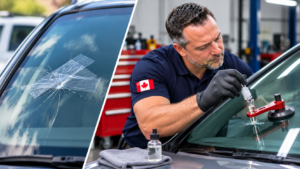
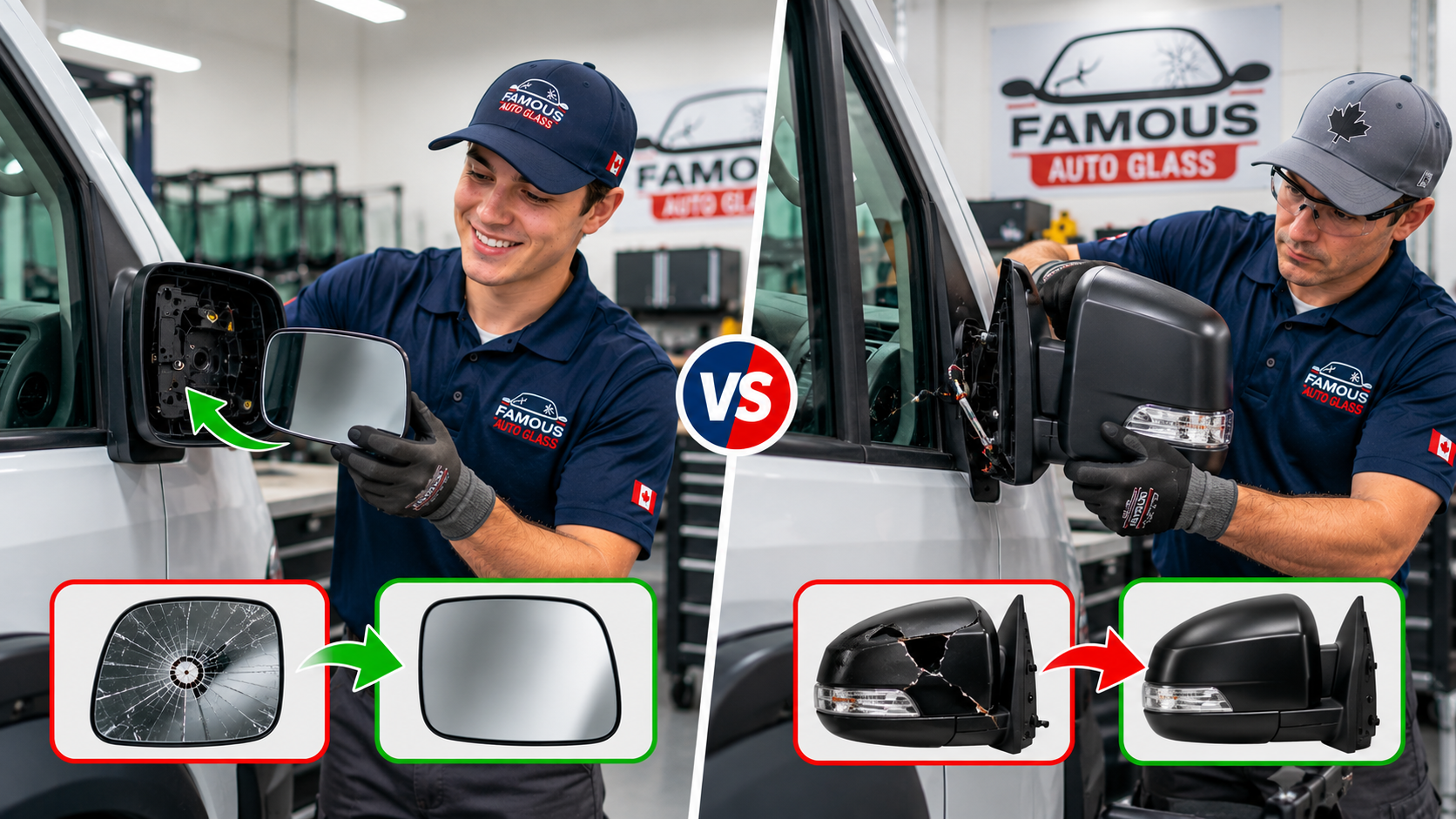
Mirror glass replacement applies when the housing itself — the plastic shell, the mounting arm, the motor if there is one — is intact, but the reflective glass is cracked, shattered, or has popped out of its mount. This is the simpler repair: the glass component is swapped, refitted into the existing housing, and reconnected if it’s a heated mirror.
Full mirror assembly replacement applies when the housing is cracked, broken off the vehicle, or has damaged internal components — the fold mechanism, the power motor, the wiring for lights or heating. In that case, the entire mirror unit is replaced as one piece, which is a larger job than a glass swap since it usually involves removing interior door panel trim to access the wiring harness.
If your mirror is “hanging” — visibly loose or dangling from the door — that’s almost always an assembly-level issue rather than a glass-only problem, since it usually means the mounting has broken or come away from the door.
What Kind of Damage Are You Actually Dealing With?
A few common scenarios, and what they usually mean:
- Cracked or missing glass, housing intact — likely a straightforward glass replacement.
- Mirror hanging by its wiring, housing cracked or detached — likely needs a full assembly replacement.
- Mirror won’t fold or adjust electronically, but looks physically fine — this may not be a glass or housing problem at all; it could be a motor or wiring fault, which is a different kind of repair.
- Mirror glass fine, but the defrost/heating no longer works — usually points to a wiring or connector issue rather than glass damage.
- Turn signal built into the mirror housing not lighting up — could be a bulb, wiring, or housing-level fault depending on the vehicle.
Getting this distinction right before booking service saves time, since a technician needs to know which scenario applies to quote accurately.
Power, Heated, and Feature-Integrated Mirrors
Modern side mirrors do a lot more than reflect light. Depending on the vehicle, a single mirror assembly can include:
- A power motor for remote adjustment
- A power-fold mechanism for tight parking
- A heating element to clear frost and condensation
- An integrated turn signal indicator
- Puddle lamps that illuminate the ground when unlocking
- A blind-spot monitoring sensor or camera, on many newer vehicles
Each of these adds a wiring connection point and, in the case of cameras or sensors, potentially a calibration step after replacement. This is a big part of why side mirror replacement cost varies so widely between vehicles — a basic manual mirror on an older economy car and a heated, power-folding mirror with an integrated blind-spot camera on a newer SUV are simply not comparable jobs, even though both are technically “a side mirror.”
What Affects Side Mirror Replacement Cost
Rather than quote a single number that wouldn’t be accurate across the range of vehicles on Toronto roads, it’s more useful to understand what actually drives the price:
- Glass-only vs. full assembly — glass replacement is generally the less expensive option; full assembly replacement costs more due to parts and labour.
- Manual vs. power-adjusted — mirrors with motors and electronics cost more than manual ones.
- Heated vs. non-heated — heating elements add a component and a wiring connection.
- Integrated features — turn signals, puddle lamps, and especially cameras or blind-spot sensors increase both parts cost and labour time.
- OEM vs. OEM-equivalent parts — factory-matched components, particularly with exact paint-code matching for the housing, can cost more than generic aftermarket parts.
- Vehicle make and model — luxury and European vehicles, and newer models with more electronics packed into the mirror, tend to cost more to service than older or more common domestic models.
A shop that asks about your specific vehicle and the type of damage before quoting a price — rather than giving a flat number over the phone — is generally giving you a more accurate picture. That’s the honest way to answer “how much does side mirror repair cost,” since the real answer depends on which of the scenarios above applies to your car.
Camera and Blind-Spot Systems in Mirrors
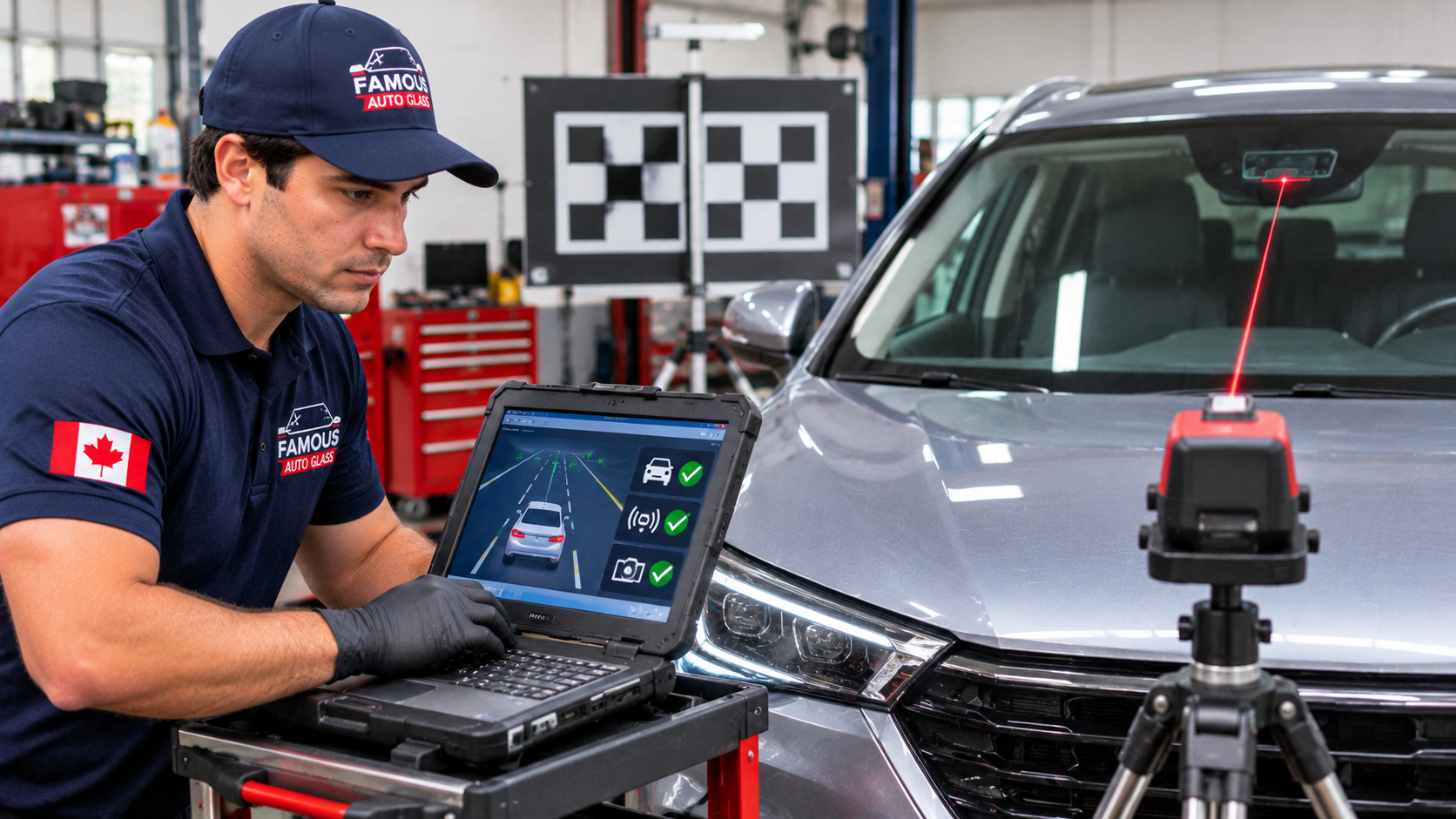
On many vehicles built in the last several years, the side mirror housing does more than hold glass — it can house part of a blind-spot monitoring system or a camera used for surround-view or lane-change assistance. Replacing this type of mirror isn’t just a mechanical swap; the new sensor or camera generally needs to be properly connected and, in some cases, calibrated so the vehicle’s safety systems continue to function as intended. If your vehicle has these features, it’s worth confirming with the shop that they have experience working with that specific system before booking.
Driving With a Damaged or Missing Side Mirror
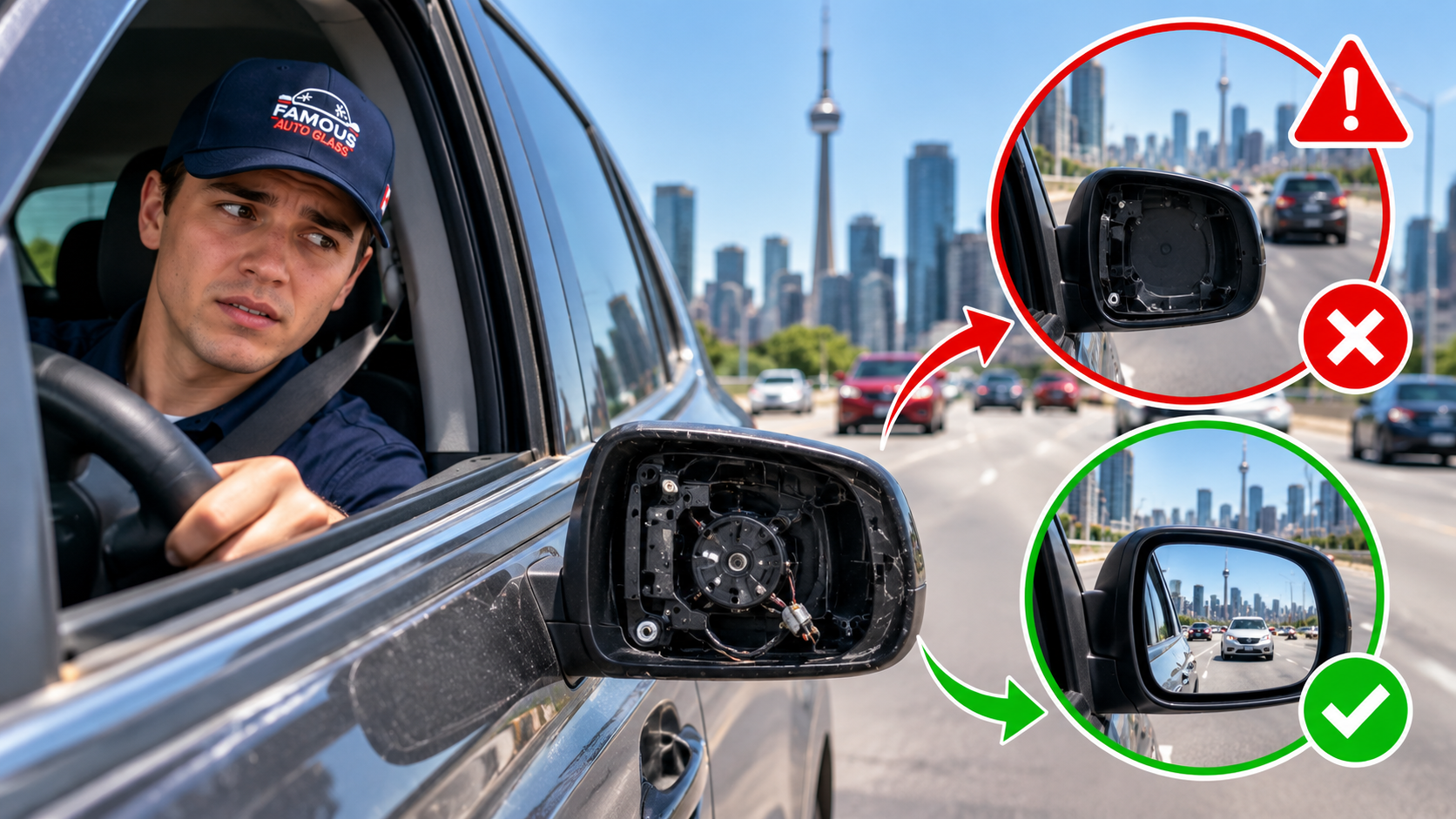
A cracked or hanging mirror isn’t just cosmetic — it directly affects your ability to see vehicles approaching from behind and to the side, which matters every time you change lanes or merge. Ontario’s Highway Traffic Act, under Section 66, requires vehicles to be equipped with a mirror or mirrors positioned to give the driver a clear view of the road behind. Driving with a mirror that’s missing, badly cracked, or non-functional can put your vehicle outside that requirement, separate from the practical safety issue of reduced visibility. If you’re unsure whether your specific situation meets the requirement, that’s a question worth directing to a licensed mechanic, an Ontario Ministry of Transportation resource, or a paralegal — it’s outside the scope of what an auto glass technician can advise on with certainty.
Practically speaking, if a mirror is damaged badly enough to affect your view of the road, treating it as something to address promptly — rather than driving around it for weeks — is the more sensible approach either way.
How Mobile Side Mirror Repair Works
Most side mirror repairs and replacements don’t require a shop visit. A mobile technician can come to your home, workplace, or wherever your vehicle is parked across Toronto, North York, Scarborough, Etobicoke, Mississauga, Brampton, Vaughan, and the wider GTA, and complete either a glass swap or full assembly replacement on-site. For power or heated mirrors, this typically includes testing the electrical connections — adjustment, heating, turn signal, and any camera or sensor functions — before considering the job complete.
If your vehicle also has other glass damage at the same time — say, a chipped windshield alongside a cracked mirror — it’s worth mentioning both when you book, since a technician can often address multiple issues in a single mobile appointment. For broader windshield questions, our guides on windshield chip repair and windshield crack repair cover that side of things in more depth. And if the damage extends to a side window rather than the mirror itself — a common combination after a parking-lot incident — our car window and door glass guide walks through that separately.
Why a Proper Inspection Still Matters
Even with a visibly cracked or hanging mirror, it’s worth having a technician confirm what’s actually wrong before assuming the worst. Sometimes what looks like a full assembly failure is actually a simpler glass or wiring fix, and getting an accurate diagnosis before committing to a repair saves you from paying for a bigger job than you actually need.