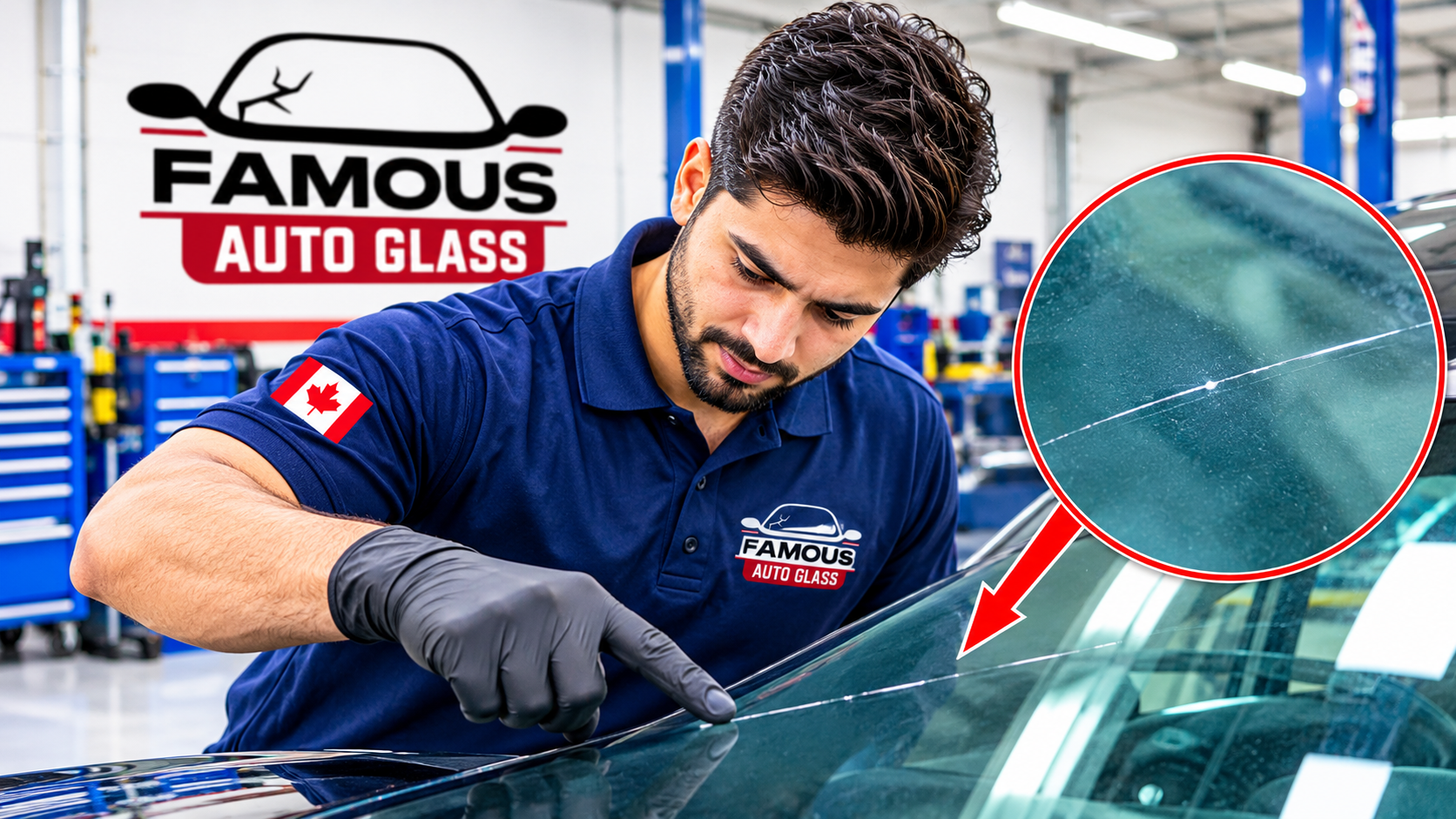
You notice it on a Tuesday morning: a thin little line near the edge of the glass, no longer than your finger. It doesn’t block your view, so you shrug and carry on. That shrug is what we hear about most often at Famous Auto Glass LTD., usually a few weeks before the same driver comes back with a crack running across the whole glass. Sometimes a tiny crack really does stay tiny, and a quick repair sorts it out. Other times it grows overnight and ends up needing windshield replacement.
This guide explains how to tell which situation you’re in, when a small crack becomes a genuine safety concern, and how to choose between a repair and windshield replacement without guessing.
Why Even a Hairline Crack Deserves a Second Look
Glass looks perfectly still, but a windshield is under stress every minute you drive. It flexes with the body of the car, expands in summer heat, contracts in winter cold and absorbs vibration from every pothole between Scarborough and Mississauga. A crack interrupts all of that. Stress doesn’t spread evenly around a break. It piles up at the tip, which is why cracks tend to run instead of staying where you found them.
Think about tearing a sheet of paper. Starting the tear is the hard part, and once there’s a nick, finishing it takes almost no effort. A tiny crack is that nick. It may sit unchanged for months, or a slammed door, a cold snap or one rough stretch of road can send it across your line of sight in seconds. Nobody can promise which way it will go, and that unpredictability is the real reason a small crack deserves attention. Catching it early usually keeps the fix small, quick and affordable, while ignoring it often pushes you towards windshield replacement.
What Your Windshield Is Actually Made Of
Your windshield isn’t a single pane. It’s laminated safety glass: two layers of glass bonded around a thin plastic interlayer. That sandwich is why a damaged windshield tends to crack and hold together instead of shattering the way a side window does. It also does several jobs you might not expect. It helps support the roof in a rollover, gives the passenger-side airbag something solid to push against and, on many newer vehicles, holds the cameras and sensors behind lane-keeping and emergency braking.
Most tiny cracks start in the outer layer. That’s the good news, because the inner layer and the plastic membrane may still be intact. The less cheerful news is that a cracked outer layer is no longer carrying its share of the load. Dirt, moisture and road salt can also work their way into the break. A windshield with a compromised outer layer is weaker than it looks, even when the crack is barely visible, which is why a “tiny” crack can still lead to windshield replacement down the track.
Five Signs Your Tiny Crack Is About to Become a Big Problem
Not every small crack is an emergency, but some are far more likely to spread. Watch for these:
- It touches the edge. Cracks that start at or reach the edge of the glass spread most readily, because the edge is where stress is greatest.
- It’s growing. If you can see it lengthen over a few days, it’s showing you what it plans to do next.
- It sits in the driver’s line of sight. Even a neat repair can leave a faint mark, and a crack here can scatter glare at night.
- It has more than one branch. Spider-web patterns and cracks with several legs usually mean the damage has travelled deeper.
- It’s dirty or wet inside. Moisture and grime make a clean repair harder, and that often tips the decision towards windshield replacement.
If your crack ticks even one of those boxes, don’t wait for a long weekend. A quick inspection will tell you whether repair is still possible.
Canadian Weather and the Crack That Keeps Growing
Few places are harder on auto glass than Canada. Ontario drivers deal with a freeze-thaw cycle that swings temperatures above and below zero in the same week. Water seeps into a crack, freezes, expands and pushes the crack wider. Road salt and gravel add to the abuse, and a stone flicked up on the 401 can turn a hairline into a long crack before you reach your exit.
Then there’s the classic winter mistake: climbing into a freezing car and blasting the defroster on full heat. Hot air on one side of cold glass creates sudden temperature stress, and a crack that was behaving itself can lengthen with an audible tick. If you have a small crack, warm the cabin gradually, aim the vents low at first and never pour hot water over the glass. A cold-morning failure like that is one of the most common reasons a “tiny” crack becomes a booking for windshield replacement.
Repair or Windshield Replacement: How Technicians Decide
A technician looks at five things: size, depth, type, location and age of the damage. A resin repair injects clear resin into the crack under pressure, bonds the break and stops it spreading. Done early, it restores much of the glass’s strength and leaves only a faint blemish. As a general rule of thumb, chips smaller than a toonie and cracks shorter than a Canadian banknote are often repairable, though the technician’s inspection has the final say.
Resin can’t rescue everything, though. If the crack is longer than that, runs to the edge, is contaminated with dirt and moisture, sits directly in the driver’s view or has damaged the inner layer, then windshield replacement becomes the safer and more honest answer. A repair that is pushed beyond its limits might look fine for a week and fail on the first bumpy road. When replacement is the right call, our team handles windshield replacement from start to finish, including proper bonding time and a final check of the fit, seals and visibility.
Why DIY Fixes and Internet Hacks Rarely Work
Every driver has heard the tricks: clear nail polish, super glue, a strip of tape. They’re tempting because they’re cheap and immediate. They’re also unreliable. Household adhesives don’t match the optical properties of laminated glass, they can seal moisture and dirt inside the crack, and they often make a later professional repair impossible. Once contaminants are locked in, resin can’t bond properly, and a fixable crack can end up costing you a windshield replacement you could have avoided.
Tape can still help in one situation. If rain is forecast and you can’t get to a shop right away, a strip of clear packing tape over the crack keeps water and debris out until the technician arrives. Treat it as a short-term shield, not a fix.
The Law, Visibility and Your Driver’s Safety Zone
A crack isn’t only a mechanical issue. It’s also a visibility issue, and visibility is regulated. Ontario’s Highway Traffic Act sets out equipment and safe-operation requirements for vehicles on the road, and a driver who can’t see clearly through the windshield is on shaky ground, both legally and practically. A small crack at the very bottom corner of the passenger side is one thing. A crack running through the part of the glass sweeping across your direct line of sight is another. If your view is obstructed, police can have something to say about it, and an inspection will usually say the same thing: this needs fixing, and sometimes that means windshield replacement.
The more practical side is glare. A crack catches headlights at night and low sun at dawn and dusk, scattering light into starbursts that make it harder to judge distance. Many drivers don’t notice how much it bothers them until the glass is fixed.
Luxury Vehicles, Trucks and Cars Packed With Driver-Assistance Tech
Not every windshield is equal, and neither is every crack. If you drive a work truck, the glass is larger, sits higher and is shaken around more on the road. Our guide on truck windshield replacement in Toronto and the GTA walks through what truck owners should keep in mind before they book. If you drive a European luxury model, the glass often includes acoustic layers, heads-up display zones and special coatings; all explained in our article on windshield replacement for luxury European cars in Toronto.
There’s another reason to take a crack seriously on newer vehicles. Forward-facing cameras and sensors are mounted to the windshield, and even a small crack near that zone can interfere with how they read the road. After windshield replacement, those systems usually need to be recalibrated so lane-keeping and collision-avoidance features work the way the manufacturer designed them. A crack that sits in front of a camera deserves an earlier look than one in a far corner.
Will Insurance Cover It? What Ontario Drivers Should Know
Many drivers put off dealing with a crack because they assume it will be expensive. Coverage depends on your policy, but in many cases glass damage falls under comprehensive coverage, and some insurers offer separate glass coverage with a lower or even zero deductible. Our article on how windshield replacement insurance works in Ontario explains the common scenarios in plain language, so you know what to ask your insurer before you book.
If you’d rather not decode policy wording on your own, our insurance claim support team can help you understand the process and what information your insurer will want. Whether it’s a repair or a windshield replacement claim, having photos of the damage, your policy details and the date it happened makes the whole thing smoother. It’s also worth knowing that waiting rarely helps. A small crack that spreads can turn a simple repair claim into a bigger one, and delaying can leave you paying more for windshield replacement than you needed to.
What to Do Right Now If You Spot a Tiny Crack
You don’t need to panic, but you do need a plan. Here’s a simple sequence:
- Take a photo. Put a coin beside the crack for scale. If it grows, you’ll have a clear before-and-after.
- Mark the end. A small dot of dry-erase marker on the outside tells you quickly if it has moved.
- Keep the cabin temperature steady. Avoid blasting hot air or cold air straight onto the glass.
- Avoid slamming doors. The pressure change inside the cabin can push a crack further.
- Book an inspection soon. Ask whether it can be repaired or needs windshield replacement, and get a clear answer before the crack decides for you.
Acting within a few days gives you the widest range of options. The longer a crack sits, the more dirt it collects and the fewer repair choices you’ll have left.